Friday, April 15, 2011

When We Two Parted

The poem When We Two Parted, written by Lord Byron, interprets the sad account of a broken-hearted narrator, recounting his feelings towards a former companion.  Feelings of loss, loneliness, regret, and ill will are evidently shown throughout the piece.
The poem is divided in to four stanzas, containing their own respective rhyme pattern throughout each of the eight verses.  In terms of diction, the use of rhyme pattern gives the work a great deal of rhythm, almost adding a sense of musicality to the poem.  The most powerful device throughout Lord Byron’s piece is most certainly the choice of words.  The strength of the words used in the poem truly conveys the narrator’s feelings to the reader.  Communicating these feelings to the reader is crucial as this poem is largely based on emotion. I think Lord Byron successfully does so throughout the piece.  In the first stanza, we learn that when the poet and his lover parted, they felt half broken-hearted, as their kisses grew colder.  These first few lines set the stage for the rest of the poem. Byron begins by setting the feeling of love lost, an “hour [that] foretold sorrow to this.”  In the beginning of the poem, the narrator speaks of the separation by describing vows which have been broken and a shameful regret in hearing his lover’s name, “a knell to [the narrator’s] ear.” All of this is connected through the thought of what the narrator suspects will happen when he and his lover meet again, and what he plans to do when he is caught in that situation.  Ironically, the narrator’s response is similar to that at the beginning of the poem.  When he and his lover parted, they parted in silence and tears.  Similarly, when he and his lover meet again, the narrator concludes that he will greet her in silence and tears.
The imagery displayed throughout the poem adds to the sense of loss and regret.  In the first stanza, the speaker explains how when he and his former other parted, “in silence and tears.”  Also, the images of a cold feeling overcoming something that was once warm truly convey the emotion that is displayed through the work.  In the first stanza, the narrator repeats the word cold to great effect: “Pale grew they cheek and cold, colder thy kiss.”  In the second stanza, the image of the “dew of the morning” gives an interesting account of the setting.  This type of description also correlates with the “shudder” described in the third stanza.  The speaker states, “they name thee before me, / a knell to mine ear; / a shudder comes o’er me–  Why wert thou so dear?” This idea gives thought to whether or not the speaker has left his lover through a heart-breaking separation or through some sort of other cause, such as death.  In this second scenario, the “dew of the morning” could represent an early morning funeral procession; “the knell to mine ear” - funeral bells. This interpretation would give the “pale cheek” and “cold kiss” a more literal interpretation.
The voice of the poem is rather regretful, filled with the idea of a great loss, that of love.  One such moment that stuck out was line 20 in the third stanza.  The speaker makes use of a rhetorical question.  He asks, “Why wert thou so dear?”  This question displays the sense of confusion that the narrator is feeling.  He wonders to himself why he loved his lover so.
The irony of the entire piece is that when the speaker meets his lover again, he plans to greet this companion the same way in which they parted, “with silence and tears.” Whether or not this poem is dealing with the loss of a lover through a sad split or through an inevitable cause, such as death, Lord Byron clearly conveys the emotions of loneliness, loss, and regret that unfortunately come with any sorrowful parting. (WC: 656)

Tuesday, March 15, 2011

The Magistrate in Waiting for the Barbarians

In the novel Waiting for the Barbarians, the story's narrator, the Magistrate, provides great insight in to the tale of a barbarian girl, victimized by the immoral acts committed by Colonel Joll.  Through the tale of this girl, and having seen the very acts committed before him, the Magistrate comes to many significant realizations.

One crucial realization that the Magistrates comes to is that the Empire is in fact the enemy. Caught between the frontier town and the way of the barbarians, and the forces of Colonel Joll (which represent the Empire), the Magistrate becomes aware of the fact that the Empire, while it makes the barbarians out to look like savage beasts, is in fact the enemy, behaving in a cruel and inhumane manner towards its less-civilized counterpart. In an argument with the Colonel the Magistrate states, "'those pitiable prisoners you brought in-are they the enemy I must fear? Is that what you say? You are the enemy, Colonel! ... You are the enemy, you have made the war, and you have given them all the martyrs they need..."' Later on in the novel, the Magistrate declares, "'the crime that is latent in us we must inflict on ourselves.' I say. I nod and nod, driving the message home. 'Not on others,' I say: I repeat the words, pointing at my chest, pointing at his.

The Magistrate wants no part of the crimes that Colonel Joll and the Empire commit. He states that he could never live with himself if he committed the crimes that the forces of the Empire did. In one instance, the Magistrate asks Mandel, as they both stand outside a gate which detains a barbarian inside, "'Forgive me if the question seems impudent, but I would like to ask: How do you find it possible to eat afterwards, after you have been ... working with people? That is a question I have always asked myself about executioners and other such people.'"

Finally, the Magistrate comes to a critical realization when he states, "I was the lie that Empire tells itself when times are easy, he the truth that Empire tells when harsh winds blow. Two sides of imperial rule, no more, no less."

Wednesday, March 9, 2011

Untried Detentions During the Apartheid Era

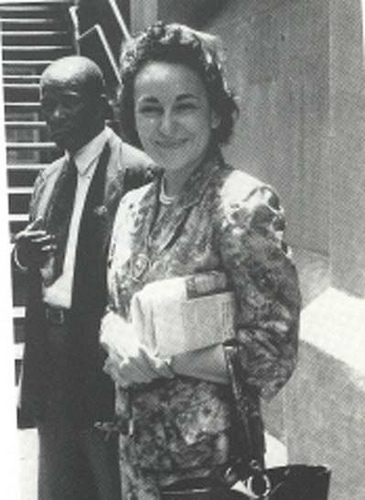
The article that I found talked about the crimes committed by the government in South Africa during the Apartheid Era.  One such crime noted was the General Law Amendment Act, in which the police force were given the ability to arrest anyone they deemed suspicious (reading this reminded me of the laws that were passed in our own state of Arizona).  Also, journalist Ruth first, author of 117 Days, was mentioned. In her book she talks about the repeatable process in which the police force would arrest people, detain them, then set them free, only to re-arrest them (as soon as they exited the police station).  The article stated that, "the primary aim of the government was to extract as much information from detainees as possible."


Link to Source - "Overcoming Apartheid"


(Pictured Above: Ruth First, journalist and author of 117 Days)


(B. J. Vorster, Prime Minister of South Africa)

Tuesday, February 15, 2011

Darcy: A Misunderstood Man In His Own Right

Sue Birtwhistle and Susie Conklin interviewed Firth to find out how he was able to portray Jane Austen’s character of Darcy in such a clear light.  Birtwhistle and Conklin ask Firth questions ranging from how he tried to communicate the dynamic of Darcy’s character, to how he felt about Darcy in certain instances, to how certain scenes affected Firth, and finally to how Firth approached certain scenes.

Colin Firth’s thesis about Darcy is that Darcy is truly an unpredictable character.  He has a lot going on inside, but reads differently on the outside.
For example, in one part of the interview Firth states, “nobody ever knows quite what Darcy’s thinking.”  Furthermore, when referring to Darcy’s love of Elizabeth, Firth says that, “Darcy’s emotional and doesn’t want her to know it, he hates her because he fancies her.”  Thus, Darcy appears to be a misunderstood character, however this is his own fault, as, through his actions, he makes people confused as to what his true intentions are.  Firth states, “so there are a million things going on inside him, yet he has to keep himself together and not show that he is in the slightest but ruffled.”  Darcy masks his feelings and emotions, which ultimately lead to him being hurt because he is not true to others, but most of all he is not true to himself.

Firth goes on to explain that triggers that led to Darcy falling in love with Elizabeth.  Firth states, “in Darcy’s case, very little had ever attracted his attention…the first trigger is the moment when Elizabeth rejects him so impertinently…Darcy was used to looking at other people like that, but was not used to being looked at like that himself.”  Psychologically, this concept is true.  People often want what they can’t have.  When Elizabeth rejects Darcy, the rejection only makes him want her more.  This rejections leads to “bewilderment” and “curiosity” of Elizabeth; it is the first time that Darcy becomes “the pursuer rather than the pursued; it’s irresistible.”  Firth says, “what starts off as intriguing becomes profoundly erotic for him.”

Firth further remarks that, “to begin with, it was a bit of sport.  And then suddenly [Darcy] is feeling vulnerable and resents it bitterly…his behavior becomes rather confusing and paradoxical–he’s pursuing and rejecting Elizabeth at the same time…[For example,] he waits in places where he knows he’ll find her walking and then doesn’t speak to her…”

Furthermore, Darcy acts one way, but wants Elizabeth to think he’s the opposite.  Firth proves this by stating as Darcy, “I’m going to put to you a proposal that may make me seem rash, irresponsible, and even, possibly, juvenile, but I don’t want you to believe I’m those things.”  This truly shows that Darcy is a misunderstood and confused character.

One question in the interview was, “Does Lizzy’s rejection effect any real changes in Darcy, then?”

Firth responded, “Oh, yes…The fact that he writes her a letter explaining himself…is ostensibly a tremendously out-of-character thing to do…”

Finally, Firth declares, “[Darcy’s] real crime, I think, is silliness.”

I believe this is true.  Everything that happened to Darcy is entirely his fault.  He and Elizabeth play silly games with each other, and one or the other often end up getting hurt, but in the end, had Darcy not been the “conductor” of these games, they would never have existed.  Yes I agree wholeheartedly with Firth. Darcy is a misunderstood character, and that is his own fault.  The relationship that he shares with Elizabeth, although it is very unusual, makes sense given the causes of such a relationship.  Darcy made things the way they were.  Had he been honest and upright in the first place with her, things might have been different.

The knowledge that Firth stated about Darcy’s character helped me to understand the man.  At first, I thought Darcy was arrogant and conceited, but after reading Firth’s thesis, I realize that Darcy is just a misunderstood man.  He kind of puts on a show for everyone, and for Elizabeth especially.  He comes off differently to people; however, being misunderstood is his own fault.

Therefore, I believe reading this interview truly helped me to get a further insight in to Darcy’s character as a whole.  

Monday, December 6, 2010

"I Can't Make You Love Me."

In Shakespeare's Twelfth Night, the characters appear to view love as a curse.  Most of the characters think of love as a force that affects its victims wildly.  The characters in Twelfth Night suffer from being in love - whether it is the force itself or the fact that their lovers do not reciprocate the same feelings. Orsino even refers to his feelings of love as "fell and cruel hounds."  Furthermore, Olivia refers to these feelings as a type of plague.  In addition, at another point Orsino refers to love as an appetite that he must fulfill, however, he is unable to.

I do not wholeheartedly agree with Shakespeare’s view on love.  I see love as a feeling that two people share together – a feeling that grows, or, in some cases, a connection that naturally exists.  I do not think it is a curse – after all, without love, life is like the seasons with no summer.  I do, however, agree with the view of Shakespeare’s characters when they state that love is a force that affects its victims wildly.  Love is unpredictable – but isn’t that the beauty of it?  I suppose that unreciprocated love could serve as a type of plague haunting its victims.  This view could also apply to Orsino’s appetite that he is unable to fulfill. 

I believe that all of Shakespeare’s views of love that he presents in Twelfth Night are all plausible ideas; however, I feel that at times they intersect with my own views.  For the sake of drama, Shakespeare’s characters do not appear to accept the reality that their love will not be fulfilled.  Rather, the characters attempt to control what is happening. They appear to attempt to change each other’s feelings – an act that I feel is impossible.

I believe that love is divine – at least true love.   It is a feeling that is naturally already there.  Love is when two forces combine to create one unique force. 

In Twelfth Night, the characters attempt to make these forces combine.  I believe that is impossible. 

However, I do agree that at times love can act as a plague.  It is undoubtedly at times, as Orsino states, an appetite that cannot be fulfilled.  Therefore, I do agree with these aspects of love that are presented in Twelfth Night.  Love can be cruel, but I think it is cruel for a reason.  There’s a sense of glory that comes with love.

Therefore, while I do not agree wholeheartedly with the ideas of love presented in Twelfth Night, I do agree with some aspects.  I don’t agree with Shakespeare’s characters thinking that they can force love upon one another.  In the words of Bonnie Raitt, “I can’t make you love me.”  Some things in life are not able to be controlled.  Just like the seasons of the year, love comes and goes.  It affects its victims wildly, happening at times when least expected.  Love does act as an appetite that can never be fulfilled, however, once it is, its true power is realized.  

Sunday, November 14, 2010

"Mama, what is my destiny?"

For this word search project, I have chosen to define and research the word destiny.  Why would I choose this word?  Because I feel that everyone has a certain destiny, and I am fascinated by this concept.  What is my destiny? What is yours?

This word means so much to me.  It is essentially what life is about.  Destiny defines our purpose.

I know that this is a very significant word.  It is defined as, "the events that will necessarily happen to a particular person or thing in the future."  To me, destiny refers to many things.  Pertaining to history, it can refer to manifest destiny and our mission as a nation.  It can refer to operas and lyrics to popular music.  Or, destiny can refer to one of the most memorable movie lines in cinematic history, "Luke, it is your destiny."

I have chosen to explore this word because at this stage of my life, I am unsure what my destiny.  There are many forks in the road, each bringing about its own sorrows and happiness, and here I sit, unsure of which way to go.

I admire the use of destiny in the film Slumdog Millionaire.  The director, Danny Boyle, has had much commentary on the idea of destiny.  Therefore, I look forward to study this word, and maybe in turn come upon some understanding as to what is written and what is not.

It seems that choosing this word might have been my destiny.

-Jeremy

Monday, November 1, 2010

An Hundred False Lapses More


By this gaude have I wonne, yeer by yeer,
An hundred mark sith I was Pardoner.
I stonde lyk a clerk in my pulpet,
And whan the lewed peple is doun y-set,
I preche, so as ye han herd bifore,
And telle an hundred false Iapes more.”

These six lines from the Pardoner's Tale are very interesting.  These lines illustrate exactly who the Pardoner is.  Basically, the Pardoner is admitting to the fact that he makes a lot of money off of a scam.  He declares that he tells "a hundred lies" to people and by doing this makes about a hundred gold coins a year.  I find these lines interesting because although they show the deceptive nature of the Pardoner, they also demonstrate his honesty.  He admits to the reader the basis of his scam.  He tells the reader that he is fake.

Furthermore, the following lines are very interesting.  They show the hypocritical nature of the Pardoner.

“But shortly myn entente I wol devyse;
I preche of no-thing but for coveityse.
Therfor my theme is yet, and ever was—
Radix malorum est cupiditas.
Thus can I preche agayn that same vyce
Which that I use, and that is avaryce.
But, though my-self be gilty in that sinne,
Yet can I maken other folk to twinne
From avaryce, and sore to repente.
But that is nat my principal entente.
I preche no-thing but for coveityse;
Of this matere it oughte y-nogh suffyse.”

Basically, the Pardoner admits to preaching out of sheer greed.  He declares that the reason why he preaches about how the love of money is the root of all evil is so that he can preach about the "same sin that I myself indulge in."

This demonstrates a meaningful quality to the Pardoner.  He almost has two personas.  One that realizes the evils of society and works to point them out and fix them, and one that indulges in these evils.

But why is the Pardoner such a hypocritical character?  Did Chaucer mean to write about such a conflicting character?

I think that the conflicting beliefs of the Pardoner make him the character he is.  Without these conflicting ideas, the Pardoner would be an average, boring character.  The reader becomes so interested in the Pardoner because he is so real, so human.  His conflicting beliefs represent the contradictory nature of humans and the societies that govern.

Monday, October 18, 2010

Chapter 3, Project #2 - Ivanhoe

In Chapter 1 of Ivanhoe, by Sir Walter Scott, there is an excerpt in which two characters have a conversation. These two characters, Wamba and Gurth, are two extremely interesting characters.  Wamba, a Jester dresses elaborately and contrasts greatly to Gurth, a swine-herd.  In this excerpt, Wamba and Gurth have a conversation in which they discuss the differences between the names of animals and the names of the food they produce.

Wamba asks, "Why, how call you those grunting brutes running about on their four legs?"  The herd repleies, "Swine, fool, swine." To which Wamba retorts, "And swine is good Saxon...but how call you the sow when she is flayed, and drawn, and quartered, and hung up by the heels, like a traitor?"  The swine-herd answers, "Pork."

I thought this conversation was really funny and interesting because it shows how things change in meaning after they have been affected in a certain way. For example, the "grunting brutes" are called swine when they are alive, but once they have been "flayed" they are known as pork.

Wamba continues, "...so when the brute lives, and is in the charge of a Saxon slave, she goes by her Saxon name; but becomes a Norman, and is called pork, when she is carried to the Castle-hall to feast among the nobles." Furthermore, Wamba declares, "Nay, I can tell you more...there is old Alderman Ox continues to hold his Saxon epithet, while he is under the charge of serfs...but becomes a fiery French gallant when he arrives before the worshipful jaws that are destined to consume him....he is Saxon when he requires tendance, and takes a Norman name when he becomes matter of enjoyment."

I thought this was very interesting.  This excerpt goes to show how that under certain circumstances, names take a significant role.  What type of name is used and how it is used sets a certain degree in conversation.  This can be linked to a more modern usage of the terms Mr. Mrs. and Ms.  We have titles and in casual conversation with friends we often leave these titles out. However, in a more professional setting these surnames are required.

Language is a beautiful thing. :)

Sunday, September 19, 2010

Through the Eyes of Wiglaf

My hero has fallen.  Beowulf stands no more. But I feel as if the time has come unexpectedly.  Had the warriors acted how they should have, Beowulf's life would have been spared.  He fought for their lives and protected our country with his life, and his very own people could not even offer their own protection.

I do not know what horrors lie ahead.  I fear the future.  Our country now lies in the hands of its invaders.  I pray that we have the strength to survive.  I cannot believe I allowed this to happen.  If only I had helped Beowulf sooner.

Regrets are better left unspoken.

Tuesday, September 7, 2010

Chapter 2: Exercises and Projects

2.  Certainly Uncertain

     "He wants you back," he screamed in to the night air like the sound of a bell that did not ring, save for the love that howled in his heart.  How could this be?  Smashed dreams live on at the site of their birth.  A tired man looks at his tired hands and knows not what lies in front of him.  He knows what it is to love, but not what it is to be loved.  In to her heart, he will beat once more.  Time is an odd thing  At any point do things in fact end?
     "I don't know," he says.  You show the world to me.  A man's thoughts live on in a boy's dream.  Two worlds crash in to one and at that hour a link is joined, one that can't be split.  Time goes by, and they meet out of the blue.  In to her heart, he beats once more.

3.  The Runic Alphabet

     (See chart) Futhorc, a runic alphabet used by the Anglo-Saxons, was descended from the Elder Futhark of 24 runes and contained between 26 and 33 characters.  It was used probably from the fifth century onward, for recording Old English and Old Frisian.  Regarding the history of the Anglo-Saxon futhorc, there are competing theories as to the origins.  One theory proposes that it was developed in Frisia, and from there spread later to England.  Another holds that runes were first introduced to England from Scandinavia where the futhorc was modified and then exported to Frisia.  However, both theories have their inherent weaknesses.

4. Alfred the Great

    Alfred the Great, born in 849, was King of Wessex from 871-899.  Alfred the Great is noted for his defense of the Anglo-Saxon kingdoms of southern England against the Vikings, becoming the only English king to be accorded the epithet - "the Great."  Alfred was the first King of the West Saxons to style himself "King of the Anglo-Saxons."  Alfred was a learned man who encouraged education and improved his kingdom's legal system and military structure.  He is regarded as a saint by some Catholics, but has never been officially canonized.  He may often be depicted in stained glass in Church of England parish churches.  His successor was Edward the Elder.  Alfred the great died in 899.

Wednesday, August 25, 2010

Blog Assignment #2

  Throughout my time, I have read numerous books, whether it be for school or for my own personal interest.  Below is a list of my top 5 books – these books range from classic tales to personal journals or guides to topics I enjoy. 
  Here is a list of my top 5 books:
1.     The Little Prince, Antoine de Saint-Exupéry. I read this book in the 4th grade, after my Father recommended that I check it out.  Ever since I picked it up in 4th grade, I’ve bought numerous copies of it and even read it a few more times.
2.     Catcher In The Rye, J.D. Salinger.  I find this book very memorable to me because I feel like I share much in common with the main character, Holden Caulfield.  Also, it’s a very honest book – what more could you ask for?
3.     Johnny Got His Gun, Dalton Trumbo.  I picked this book up after watching the film.  I think it’s a very meaningful story.
4.     Rebel Without A Crew, Robert Rodriguez.  I picked this book up in a book store after I graduated the 8th grade.  As my interest in film grew, I began reading books about how to make films.  Robert Rodriguez is one of my favorite directors, and his book follows the journey that he took in making his first film.  This book has served as a guide for my future filmmaking techniques and the way I approach making a film.
5.     Understanding Movies, Louis Giannetti.  My Grandparents sent me this book.  It includes some very interesting analyses of many popular films.

Monday, August 23, 2010

Blog Assignment #1

    Over the course of the summer, I chose to read two books: Frankenstein, a novel written by Mary Shelley during the 18th century, and A Clockwork Orange, a novel written by Anthony Burgess and published in 1962.  As I stared blankly at the two books that rest beside me on my nightstand, I thought about the stories that these two novels held.  I had not done any background research on the material of these two books, so I was in for a surprise.  And so, with this curious attitude, I picked up the first book.  I stared at the cover in confusion. The title glared back at me in large letters: FRANKENSTEIN.  Thus began my journey in to the mind of Mary Shelley and through an 18th century world.
    The story begins with a Captain Robert Walton embarking on a journey to explore the North Pole.  Through his correspondence with his sister, Margaret Walton Saville, we learn that Captain Walton is on a mission to achieve fame through scientific exploration.  Unfortunately, the Captain’s ship becomes trapped in a barrier of broken ice.  During their “captivity,” the crew notices a man on a sled in the distance.  Later, a man is found floating on a raft near the boat.  The crew rescues this man and brings him to the Captain’s attention.  As Frankenstein begins to recover, he begins to talk to Captain Walton.  It is through this encounter that we learn of Frankenstein’s tale.  At first, I was confused with the many transitions that took place.  The book travels from the letters of Captain Walton and then to Frankenstein’s narration of his journey.  Although at first confusing, this transition proved to be extremely clever.  Through Frankenstein’s tale, we learn that he, like Captain Walton, embarked on his own journey to achieve fame through scientific exploration.  His mission was to create a being that he could share his desires and feelings with.  After months of preparation, Frankenstein succeeded, however, his creation was disastrous.  Built from a collection of bones from charnel-houses, Frankenstein’s creation was a hideous catastrophe.  Frankenstein, fearful of what he has done, flees the scene of his creation.  The rest of the novel explains Frankenstein’s later encounters with his horrid creature and the revenge plots that ensue.  After Frankenstein’s monster wreaks havoc on society in an attempt to find a companion, Frankenstein vows to destroy his creation.  Through a plethora of events, we are taken back to the place of the beginning.  Frankenstein is travelling the North Pole in hopes of finding his monster and destroying it.  After Frankenstein’s narration, we are taken back once again through a transition to Walton’s narration.  Walton concludes with Frankenstein’s unfortunate death, due to an illness gained from the long journey to find his monster.  At the end of the novel, Walton goes to check on Frankenstein and finds the monster mourning over his master’s body.  After confronting Captain Walton, the monster leaves in sadness, never to appear again. 
    Personally, I think this was a well-written novel.  Once I was aware of the transitions that Mary Shelley was using, I enjoyed her clever storytelling and her use of frame story.  I thought the ending was kind of abrupt – with the monster’s brief appearance and disappearance.  I hoped for more of a conclusion – possibly with Frankenstein and his monster coming face-to-face and finding some sort of agreement.  I hoped for Frankenstein to be freed from the guilt that ensued his journey (due to the death of his friends and family by his monster’s hands).  I hoped for the monster to gain a companion and friend and live like he wished.  Shelley really personalized the character of the monster.  I felt his pain and sadness, living in a lonely world that judged him by his appearance and not his true character.  Therefore, due to the themes and characters that Mary Shelley utilized in her novel, I found Frankenstein to be a very worthwhile and pleasing novel.

-           -  JABDO

WORD COUNT: 660